Summary: Understanding the types of construction cranes helps you avoid delays, minimize safety risks, and stay within budget. By matching each crane to specific site conditions, lift needs, and project timelines, you ensure efficient progress. Choosing the wrong equipment can disrupt your schedule and damage your reputation, but the right partner helps you select equipment that maintains safety, controls costs, and keeps your project moving smoothly.
Why Understanding Types of Construction Cranes Matters
You’ve scheduled a critical lift, coordinated crews, and aligned timelines—only to realize the crane on-site can’t meet your project’s requirements. Now you’re facing delays, added costs, and tough conversations with stakeholders.
This is why understanding construction cranes is essential. Your equipment choice impacts your timeline, safety, and profitability. Colorado’s unpredictable weather and terrain leave little room for error.
When you select the right crane from the start, you reduce risk across every phase of your project. It’s not just about lifting capacity—it’s about ensuring the entire operation runs as planned.
- Costly delays: Equipment mismatches can halt progress, forcing rescheduling and impacting downstream trades.
- Safety risks: Improper equipment increases the likelihood of incidents and compliance issues.
- Budget overruns: Last-minute changes, additional rentals, and downtime add up quickly.
- Reputation damage: Missed timelines and visible setbacks reflect directly on your leadership.
Before diving into specific crane types, recognizing your options up front puts you in control and helps you avoid preventable setbacks as you move through the selection process.
Common Types of Construction Cranes and Their Uses
Different projects demand different solutions. Understanding how each crane functions—and where it performs best—helps you make confident, informed decisions when evaluating types of construction cranes.
Mobile Cranes
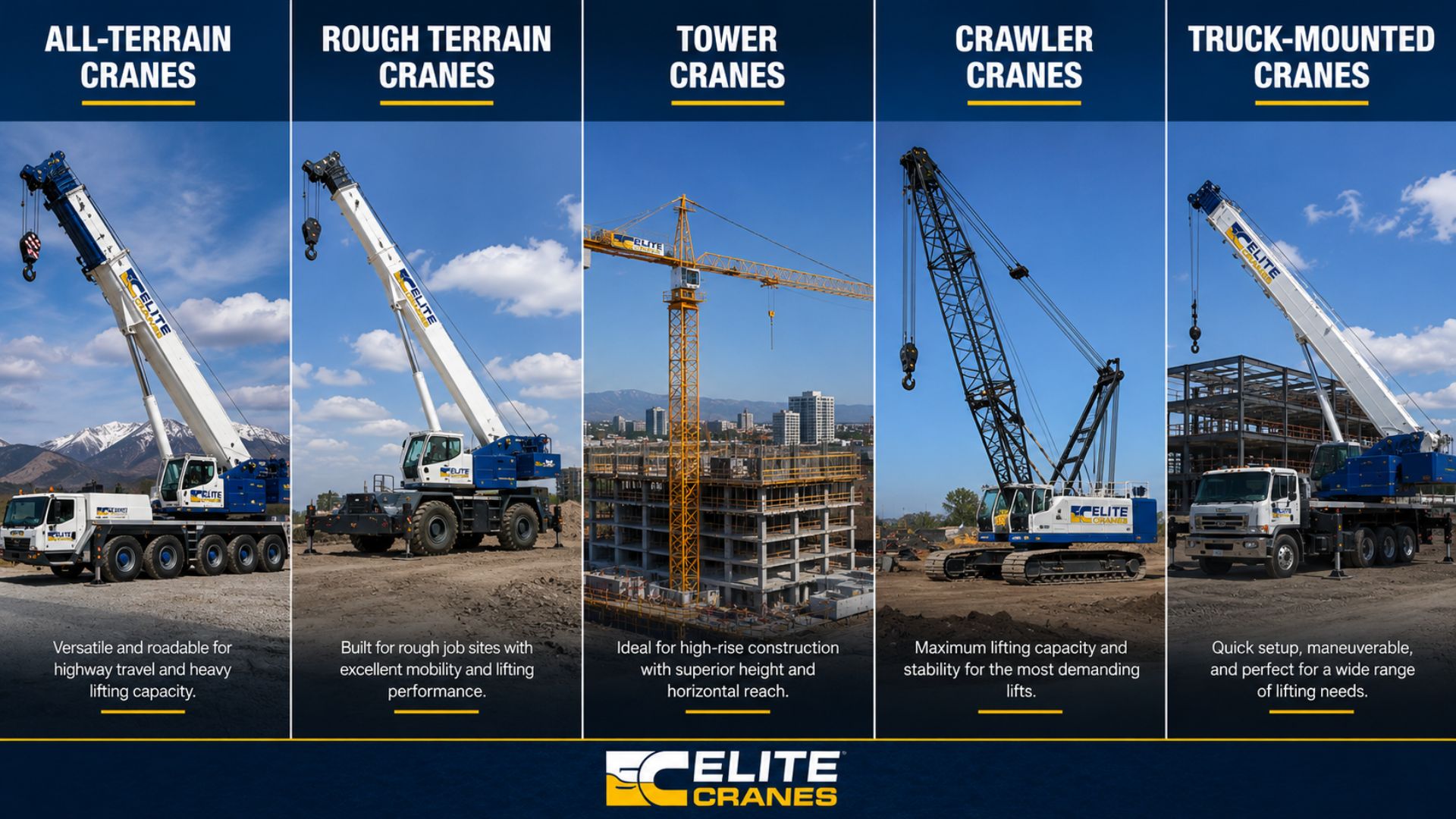
Mobile cranes are among the most widely used options because they balance power and flexibility across a variety of job sites.
- Flexible mobility: Mobile cranes are ideal when your project requires quick setup and repositioning.
- Multi-site efficiency: They perform well across multiple job locations in a short timeframe.
- Reliable performance: These cranes handle a wide range of lifting tasks without requiring complex setup.
This versatility makes mobile cranes a go-to option for many commercial and industrial applications where adaptability is key. Next, let’s consider all-terrain cranes and where they best fit.
All-Terrain Cranes
All-terrain cranes are designed to handle the transitions that many Colorado projects require, from paved roads to rugged job sites.
- Versatile operation: Designed for both highways and rough terrain, these cranes adapt to changing site conditions.
- Strong lifting capacity: They provide power and flexibility for mid- to large-scale projects.
- Ideal for Colorado conditions: Perfect for projects transitioning between paved and uneven surfaces.
If your job site conditions vary, these types of construction cranes provide the flexibility to keep your schedule intact while minimizing disruptions. When the terrain becomes particularly unforgiving, rough terrain cranes may be your next consideration.
Rough Terrain Cranes
When your construction project takes you off the beaten path, rough terrain cranes are built to perform where other equipment struggles.
- Off-road capability: Built for uneven ground, steep grades, and challenging environments.
- Compact strength: Their design allows them to maneuver in tight, rugged spaces.
- Job site reliability: A strong choice for infrastructure and industrial work in remote locations.
These cranes are especially valuable in areas where access and stability are major concerns, particularly in more rugged parts of Colorado. For projects where building upward is a priority, tower cranes may offer the advantages you need.
Tower Cranes
For vertical construction, tower cranes provide the height, reach, and consistency required for long-term builds.
- Height advantage: Essential for high-rise and large-scale vertical construction.
- Stability at elevation: Fixed positioning allows for precise lifts at significant heights.
- Efficient material handling: Ideal for continuous vertical movement over extended timelines.
Tower cranes become more cost-effective as project duration increases and vertical demands grow, especially in dense urban environments. For projects demanding both heavy lifting and site adaptability, crawler cranes could be the next solution to consider.
Crawler Cranes
Crawler cranes are made for heavy lifting and stability in conditions where other types of construction cranes may not perform as well.
- Superior stability: Track-mounted systems distribute weight effectively on soft or uneven ground.
- Heavy lifting power: Excellent for large infrastructure and industrial applications.
- On-site mobility: They move across job sites without requiring additional transport.
For projects requiring both strength and adaptability, crawler cranes are often paired with detailed lift planning services to ensure safe execution. For jobs that require swift deployment and tight turnaround times, truck-mounted cranes might be your best match.
Truck-Mounted Cranes
Truck-mounted cranes offer a balance of speed and efficiency, particularly for projects with tight timelines.
- Quick deployment: Mounted on a truck chassis for fast setup and mobility.
- Urban efficiency: Ideal for projects with limited space or access constraints.
- Flexible scheduling: Works well when timing and repositioning are critical.
For shorter-duration jobs or multiple lift locations, this option keeps operations moving without unnecessary delays.
Related: Hydraulic Crane Rental in Denver: Advantages in Tight Spaces
How to Match the Right Cranes to Your Project
Choosing the right crane means understanding your project’s demands. Evaluate beyond simple specs and consider site factors affecting performance.
Taking a strategic approach ensures your crane supports—not slows down—your progress.
Project Size and Scope
The scale of your project plays a major role in determining which crane will be most effective.
- Large-scale demands: Tower and crawler cranes handle heavy loads and long-term projects.
- Smaller jobs: Mobile or truck-mounted cranes offer efficiency for shorter timelines.
Matching crane capacity to project scope prevents both underperformance and unnecessary expense.
Site Conditions
Your job site often dictates the types of construction cranes that can realistically operate safely and efficiently.
- Terrain challenges: Rough terrain and crawler cranes excel on uneven or soft ground.
- Access limitations: Compact cranes perform better in confined or urban environments.
Evaluating site conditions early helps you avoid equipment that can’t function as needed.
Height and Reach Requirements
Every project has different lifting requirements, and choosing the wrong crane can limit your ability to execute efficiently and on budget.
- Vertical construction: Tower cranes provide the necessary elevation and reach.
- Variable lifts: Mobile cranes offer flexibility for changing lift heights.
Understanding these requirements ensures your crane can handle every phase of the build.
Timeline and Flexibility
Your schedule should influence your equipment choice just as much as technical requirements.
- Fast-paced projects: Mobile and truck-mounted cranes allow quick setup and repositioning.
- Long-term builds: Tower cranes become more efficient over extended durations.
Balancing speed and efficiency helps keep your project on track from start to finish.
Also on our blog: Relocating Industrial Machinery: How Elite Cranes Helps to Minimize Downtime and Risk
Avoiding Costly Mistakes When Choosing Crane Equipment
Even experienced project managers can run into issues when crane selection is rushed or based on incomplete information. Understanding common mistakes helps you avoid unnecessary setbacks when evaluating types of construction cranes.
Making the right decision requires looking at the full picture—not just the lift itself.
- Underestimating capacity: Leads to unsafe lifts, delays, and potential compliance issues.
- Overestimating needs: Results in higher rental costs without added value.
- Ignoring site constraints: Creates situations where equipment cannot operate effectively.
- Overlooking weather impact: Colorado’s wind, elevation, and seasonal shifts can disrupt operations.
By taking a comprehensive approach to planning, you reduce risk and maintain control over your timeline and budget. For additional safety considerations, review the Occupational Safety and Health Administration’s crane operation standards.
Why Choose Elite Cranes
When you’re evaluating types of construction cranes, you’re not just choosing equipment—you’re choosing a partner who plays a role in your project’s success.
Working with a provider who understands your challenges helps eliminate uncertainty and improve overall performance.
- Reliable equipment: A diverse fleet of cranes and related equipment matched to your project’s exact requirements.
- Certified operators: Skilled professionals focused on safety and precision.
- Local knowledge: Experience with Colorado’s terrain, weather, and regulations.
- Proactive planning: Identifying potential challenges before they impact your timeline.
- Transparent communication: Clear expectations with no surprises.
- Partnership approach: Support that aligns with your goals, not just equipment delivery.
With the right support, you gain confidence that your lifting operations will be handled efficiently and professionally. Whether you’re planning ahead or need immediate support, connecting with a team that specializes in crane rental services in Colorado Springs ensures you’re set up for success.
Take the Next Step with Confidence
Choosing the right types of construction cranes can prevent unnecessary complications that lead to delays and added expenses. When your crane equipment aligns with your project’s needs, everything from scheduling to safety becomes easier to manage.
If you want confidence in your equipment selection, call Elite Cranes today. You’ll get straightforward answers, reliable scheduling, and support that helps keep your project on track, safe, and within budget.